
Ask the Expert: Central & South Carolina Power Team Discuss The Partnership Driving Power, Infrastructure, and Economic Growth
Economic development and energy planning are increasingly connected as South Carolina attracts new businesses, investment and jobs. For the state’s electric cooperatives, supporting that growth requires close coordination, so communities have the infrastructure and reliable, cost-effective power needed to serve new and expanding industries.
That coordination is at the heart of the partnership between Central Electric Power Cooperative and the South Carolina Power Team. As the generation and transmission cooperative owned by the electric distribution cooperatives, Central works closely with the South Carolina Power Team. The South Carolina Power Team is the economic development organization representing the state’s consumer-owned electric cooperatives.
Together, Central and the South Carolina Power Team bring complementary expertise to economic development opportunities across the state. The Power Team helps identify and advance opportunities for new investment, while Central addresses the power supply, transmission and long-term energy needs that increasingly shape major economic development decisions.
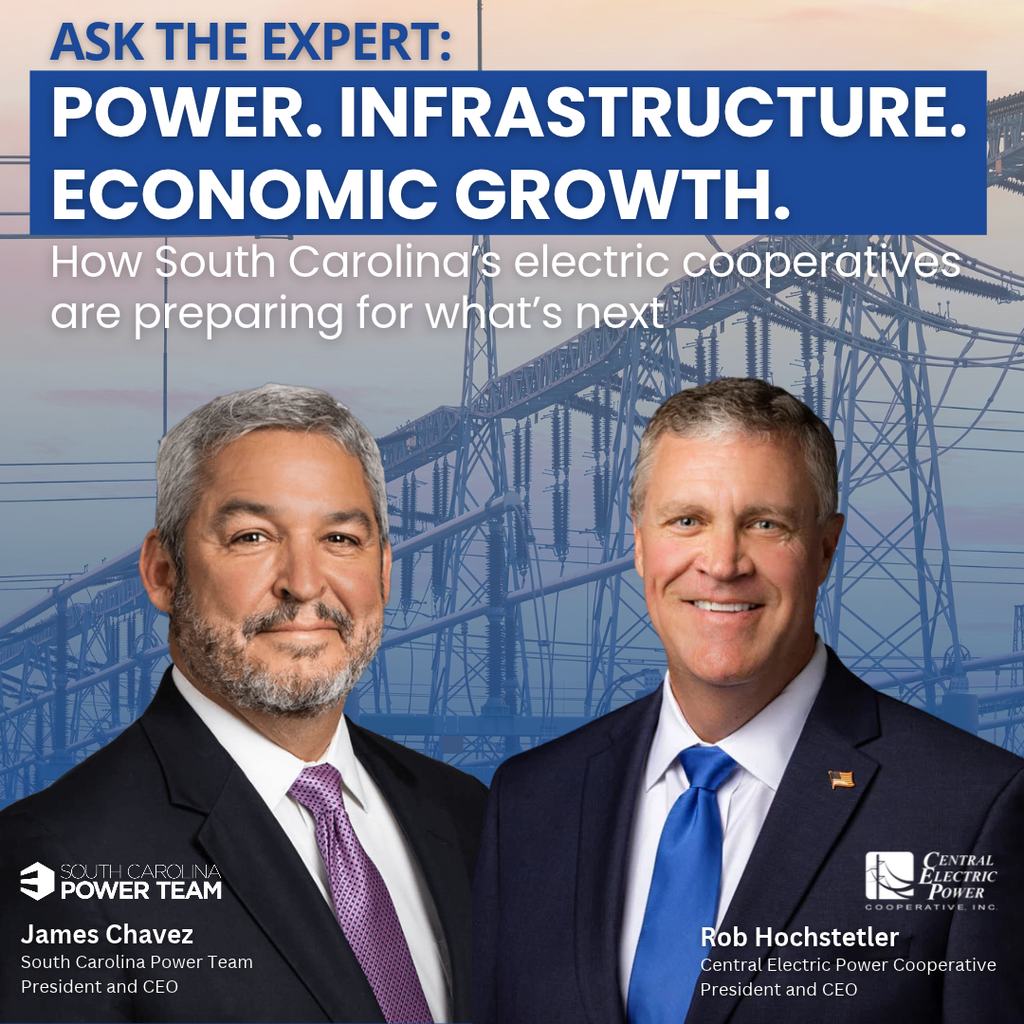
For this edition of Ask the Expert, Central President and CEO Rob Hochstetler and South Carolina Power Team President and CEO James Chavez discuss how their organizations work together, what economic development means for cooperative members and how they are preparing for South Carolina’s continued growth.

Rob – James and I have a strong working relationship because Central and the South Carolina Power Team are focused on the same outcome: helping South Carolina’s electric cooperatives and their communities compete and grow. Economic development is a team sport, and cooperatives work together to create the scale needed to compete locally, statewide, nationally and internationally.
James brings decades of economic development experience, strong relationships and a proven team that consistently produces results for South Carolina. Central’s role is to make sure the Power Team and our member cooperatives have the support they need to compete effectively, whether that means rate analysis, technical expertise, power supply insight, transmission coordination or, when appropriate, financial tools.
We each bring different tools to the table, but we are working from the same cooperative playbook: strengthening our member cooperatives, supporting the communities they serve and helping bring jobs and investment to South Carolina.

James – When I arrived 13 years ago, I quickly learned that Central plays a critical role for our electric cooperatives. Through Central, our cooperatives created a vehicle for funding and board representation, making a historic commitment to foster growth across the state.
Today, we rely on and work closely with every member of the team. The complexity and size of projects requires that we stay on the same page. There is no success for one of us if the other is not doing their part.
As for Rob and me, we have a very close working relationship. We have been able to have hard conversations about major topics because we trust where the other person is coming from and know we both care deeply about the organizations we serve. He has been an incredible partner and friend.
Rob – A successful partnership is measured by how well we help our member cooperatives compete and serve their communities. That means being responsive, coordinated and realistic when opportunities arise. The South Carolina Power Team helps identify prospects, understand what companies need and keep projects moving through the economic development process.
Central helps evaluate whether and how the electric needs can be met in a reliable, competitive and timely way. Our member cooperatives bring the local relationships, community knowledge and direct connection to the end-use member. When the partnership is working well, prospects receive clear answers, communities are prepared, risks are understood early, and our cooperatives are positioned to win projects that create long-term value for the communities we serve.
James – Two different teams that know who we serve and what we are charged to do every day. We both have cultures of service, to our electric cooperatives and to our communities. At a time where every project conversation includes energy (cost, availability, time to deliver, source), we are talking every day or meeting together with prospective companies on behalf of our electric cooperatives.
Gratefully, we both have team members with little ego, servant hearted, know our lanes, and who truly enjoy each other. It makes this role such a blessing!
Rob – Two major examples that show the value of this partnership are Samsung in Newberry County and Volvo in Berkeley County. They are not brand-new projects, but they remain important examples of the kind of transformational investment that can occur in cooperative-served territory when the right partners are aligned. Projects of that scale require more than a good site. They require confidence in the community, workforce, transportation, permitting, electric service, infrastructure and long-term operating costs.
The South Carolina Power Team helps position cooperative-served territory for those opportunities and works with prospects and economic development partners throughout the process. Central helps support the power supply, rate, transmission and technical questions that become critical as projects move from interest to reality. The benefits are significant: jobs, capital investment, stronger tax bases, new opportunities for local suppliers and long-term growth for the communities our member cooperatives serve. Samsung and Volvo are good reminders that economic development is not just about landing one company; it is about creating momentum that can strengthen a region for years.
James – In an ideal situation, the Power Team, Central and the local cooperative are in lock step and working through each phase of the project together. That is when we are all at our best. During the life cycle of the project there will be various times where one entity is taking the lead and the rest are in support roles.
Nearly every project we work on requires collaboration between the Power Team, Central and the local electric cooperative. We collaborate on any number of project requirements such pricing, incentives, evaluating load ramps, delivery of capacity, etc.
Some notable examples include: Volvo, Samsung, Google, Meta, QTS, Sodecia (Scout supplier), Eaton Corporation, TS Conductor.
James – Economic development success helps put downward pressure on costs for residential and commercial members across the State. South Carolina’s model is unique with all cooperatives sharing all costs, but they also all benefit from new revenues that come in when larger load projects land in cooperative territory.
Also, the cooperative commitment to drive growth in our State has meant thousands of good paying jobs coming into our territory. For decades, job opportunities were largely in city centers.
Now they are broadly distributed across South Carolina, especially in the most rural communities we serve.
These jobs carry the potential to change the trajectory of family trees for those members we serve across the State.
Rob – Economic development success can help put downward pressure on rates because it brings new electric load onto a system with significant fixed costs. Transmission, substations, power supply planning and other system investments must be paid for whether the customer base is growing or not. When new industrial or commercial load is added in the right way, more kilowatt-hours help share those fixed costs across a broader base.
That does not mean every project automatically lowers rates, and we have to be disciplined about the infrastructure required to serve each opportunity. But thoughtful growth can strengthen the financial foundation of the cooperative system, improve utilization of existing assets and help reduce the upward pressure that would otherwise fall more heavily on residential members. In plain terms, good economic development helps bring more shoulders under the same load.
Rob – Economic development is truly a collaborative effort between Central and the South Carolina Power Team. As the Power Team recruits new businesses to our state, they keep us informed about anticipated project timelines, power requirements and expected load growth. That allows our Corporate Planning team to incorporate those projects into our long-term load forecasts and determine whether additional generation resources will be needed.
At the same time, our Transmission Planning team evaluates potential sites within our member cooperatives’ service territories to ensure they can be served reliably. If transmission upgrades or additional generation are needed, we begin planning well before the customer comes online. By working together and sharing information early in the process, we’re able to support economic development while maintaining reliable, affordable service for all of our member cooperatives.
James: From the perspective of infrastructure to the site, our Site Readiness Fund was designed to ensure that when we are developing sites we are also ensuring that there will be sufficient infrastructure to support any industry that will come into that site. To date, the electric cooperatives have invested well over $73.9 million to develop market ready sites. That financial commitment has attracted an additional $269 million from partners such as counties, Department of Commerce and local electric cooperatives.
Since 2014, the Site Readiness Fund has played a key role in industrial announcements totaling more than $9 billion in new capital investment, 9,998 new jobs, and 1.5 gigawatts in new electric load to our system.
Rob: Central works closely with its Members to develop long term load forecasts that reflect anticipated growth. This requires a significant amount of local data and extensive conversations with local cooperative employees. These forecasts are the foundation of both transmission and generation planning. Central works with Santee Cooper and Duke Energy Carolinas to develop transmission plans to accommodate forecasted growth, and Central and Santee Cooper have a well developed generation expansion planning process that is designed to develop a fleet of resources to serve load growth in South Carolina.
Rob – The most exciting development in South Carolina’s energy sector is that electricity is no longer in the background of economic development; it is now one of the deciding factors. Companies are asking early about available capacity, transmission, rates, reliability and timing. That is especially true for advanced manufacturing, data centers, AI-related infrastructure and other large-load projects.
South Carolina is well positioned because our cooperative system understands how to work together, but we also have to be disciplined. Growth only helps our members if it is planned carefully, priced appropriately and supported by the right infrastructure. The opportunity ahead is to compete aggressively while protecting the reliability and affordability our residential and commercial members depend on.
James – South Carolina is a manufacturing State. So our team has been excited about working the more traditional manufacturing projects that are less intensive power users, but create lots of jobs and capital investment.
Regarding the energy sector, having broad based support to bring generation resources online is something we all can get excited about. The team at Central is working everyday to make sure we continue to provide reliable and affordable power to the citizens we serve, and ensuring that we can stay open for business.
Thank you to Rob and James for this conversation and their ongoing partnership to benefit the members of South Carolina’s electric cooperatives.


- « Previous
- 1
- …
- 3
- 4
- 5