Ask the Expert: turning data into decisions
Every day, Central employees use their expertise to support our members, strengthen the electric grid and keep the cooperative running efficiently. Through our new Ask the Expert series, we’re highlighting the people behind the work and sharing insights into the roles, technologies and challenges that help power our organization.
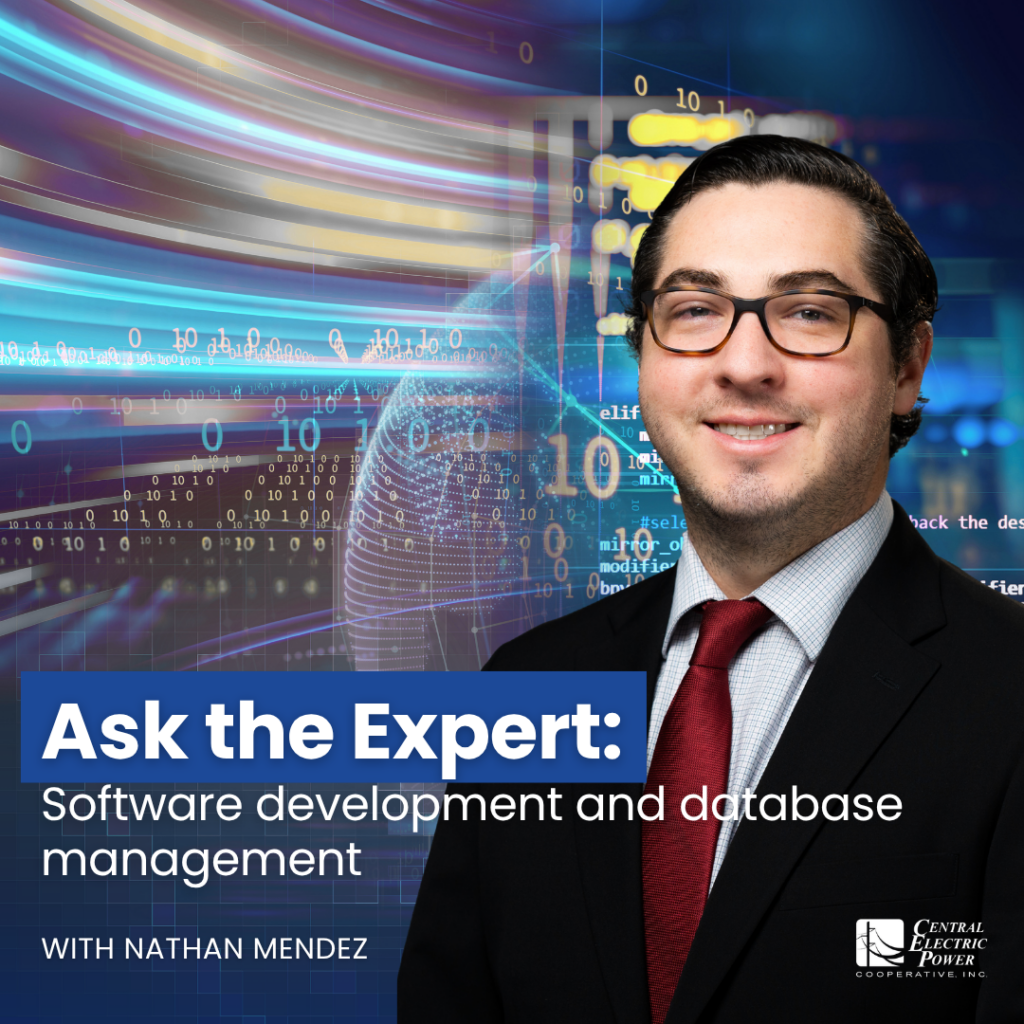
In this edition, we feature Nathan Mendez, Applications Developer/Database Administrator, whose work helps transform complex data into meaningful information for employees and member cooperatives. From developing software applications to managing databases and supporting tools like MeterHub, Mendez plays a key role in helping Central make data-driven decisions. He also shares his perspective on emerging technologies, common misconceptions about software development and advice for those interested in a technology career in the utility industry.
Tell us about your role as Applications Developer/DBA at Central.
As an Applications Developer/Database Administrator at Central, I design, develop and maintain software applications and databases that support the organization’s operational and business needs. My role involves creating solutions that improve how data is collected, managed and shared across the company while ensuring our software and databases remain secure, reliable and efficient.
I work closely with employees and member cooperatives to develop tools that provide better visibility into critical information, helping teams streamline processes and make more informed decisions using data.
How long have you been with Central and what led you into software development and database management?
I’ve been with Central for two years.
My interest in software development started in college while taking differential equations, where I realized I enjoy solving complex problems. Programming gave me a way to combine logic, creativity and problem solving into something practical.
As I continued my coursework, I found myself drawn to projects that involved building solutions and automating processes. I enjoyed breaking down complicated challenges into smaller, manageable pieces and finding efficient ways to solve them. Over time, I expanded into database management, where I discovered the importance of organizing, maintaining and analyzing data to support business decisions.
What I enjoy most today is developing systems and processes that help turn large amounts of data into useful information that our members can rely on.
What types of applications and systems do you support?
Central supports a range of applications and systems that help transform operational data into meaningful insights for employees and members.
One primary external application is MeterHub, a member-facing portal that provides transparency into metering data. Members can access reporting tools, data analytics and meter validation information for the meters they serve.
Internally, I support several applications that help track and manage assets across the cooperative system. These tools provide efficiency and visibility into operational equipment and transmission asset specifications, while improving cross-departmental coordination. By having accurate information, these systems support planning, maintenance activities, inventory management and billing processes.
A large part of what I do at Central happens behind the scenes and involves integrating data from multiple systems into a centralized environment for reporting and analysis. We collect information from several external platforms, as well as through automated file transfers using secure processes such as SFTP (Secure File Transfer Protocol). Once the data is received, we use data workflows to validate, clean and standardize the information before making it available for reporting and analytics.
How are data and software changing the electric utility industry today?
Data and software are transforming the electric utility industry by providing greater visibility into how the grid operates and enabling teams to make faster and more informed decisions.
Utilities can analyze large amounts of data from meters, substations and other equipment to improve reliability and identify issues before they become a problem.
What emerging technologies are you most excited about from a utility perspective?
Artificial intelligence and advanced analytics have the potential to help utilities make better use of the large amounts of data generated across their systems.
By identifying patterns and trends that might otherwise go unnoticed, these technologies can support more informed decision making, improve operations and enhance reliability. As the industry continues to evolve, AI and advanced analytics can help utilities become more proactive, efficient and resilient.
What is your favorite part of your job?
My favorite part of my job is helping bring people’s ideas to life.
They come to me with a challenge or an idea for improving a process, but they aren’t sure how to make it happen. I enjoy working through the problem, designing solutions and building something that turns their vision into reality.
What’s a common misconception people have about database and application development?
I think a common misconception is that database management and application development is just about writing code.
A large part of the job is understanding people’s needs, identifying problems and designing a solution that fits into how they work. Success often depends on communication, planning and understanding business processes.
The best solutions come from working closely with users to turn ideas and challenges into tools that make their jobs easier.
What advice would you give someone interested in a career in technology within the utility industry?
Focus on being a great problem solver and never stop learning.
Technology changes quickly, but the ability to understand a problem and create a solution will always be valuable. It’s also important to learn the business side of things and understand how your work impacts the people who rely on the systems.
Listen to your co-workers, ask questions and be willing to take on a challenge outside of your comfort zone. The more you understand both the technology and the business, the more effective you’ll be.